
The question surrounding the Calder Trophy race is becoming harder to ignore: has Matthew Schaefer already done enough to win?
As the 2026 NHL season winds down, the rookie conversation remains one of the league’s most compelling storylines. Several first-year players have built strong cases and positioned themselves as legitimate finalists. But while the race appears competitive on the surface, Schaefer’s season continues to separate itself in both context and overall impact.
And that’s where the debate shifts.
At just 18 years old, Schaefer has recorded 22 goals and 58 points — production that is impressive in any situation, but even more remarkable given his role as a defenseman. Offensive output from the blue line at this level is rare, and historically, players at his position require years to reach this kind of consistency.
Schaefer has done it immediately.
More importantly, his value extends far beyond the scoresheet. He’s logging meaningful minutes, contributing in all situations, and influencing the game at both ends of the ice. The level of responsibility he’s been trusted with — especially at his age — adds significant weight to his Calder Trophy case.
This isn’t just about production. It’s about impact.
Still, the race isn’t without serious challengers.
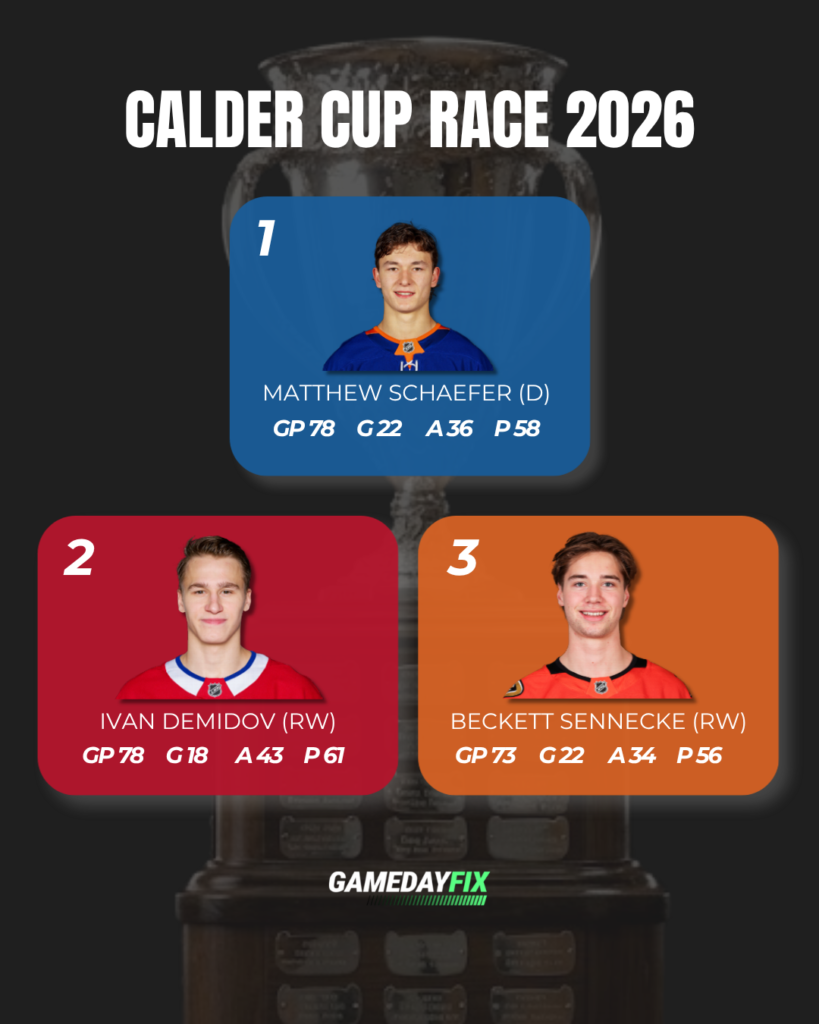
Ivan Demidov has led all rookies in total points, consistently driving offense and showcasing elite playmaking ability throughout the season. Beckett Sennecke, meanwhile, has emerged as one of the top goal scorers in this rookie class, matching the lead in goals and proving to be a reliable finisher night after night.
Both players have built strong statistical résumés — and under traditional voting patterns, that kind of offensive production often carries significant influence.
But context matters.
High-end scoring from forwards is expected. A defenseman producing at this level — while also handling top-pair responsibilities — is not. When factoring in positional difficulty, usage, and two-way impact, Schaefer’s season begins to stand apart in a much more meaningful way.
It becomes less about who leads the stat sheet — and more about who has delivered the most complete season.
From a voter’s perspective, that distinction is critical.
There is still time left in the season, and late surges can always influence perception. A strong push from Demidov or Sennecke could tighten the race heading into the final stretch. But as it stands, Schaefer has already built a body of work that is difficult to overlook — one that combines production, responsibility, and historical significance.
And that combination is often what defines a Calder Trophy winner.
Because in the end, this award has never been just about numbers.
And if that holds true again this year, the Calder Trophy race may not be as open as it seems.