The road to another Hlinka-Gretzky Cup title begins Wednesday afternoon as Canada U18 takes on Slovakia U18 in its opening game of the prestigious international tournament. Puck drop is set for 4:00 p.m. ET, with coverage available on RDS and TSN.
Every August, the Hlinka-Gretzky Cup serves as one of the first major showcases for many of the world’s top NHL Draft prospects. For Canada, expectations never change. The tournament has become a proving ground for future NHL stars, and this year’s roster is loaded with elite skill, speed, and depth.
Canada enters the matchup as one of the tournament favorites thanks to its relentless forecheck, high-powered offense, and strong blue line. While many of these players are still making a name for themselves, several are already viewed as potential first-round selections in future NHL Drafts. Team Canada typically thrives on playing fast, controlling possession, and creating scoring chances off the rush.
Slovakia, meanwhile, continues to establish itself as one of Europe’s rising hockey nations. The program has produced several NHL talents in recent years and will look to frustrate Canada with disciplined defensive play and opportunistic scoring. The Slovaks know they’ll likely spend stretches defending, making goaltending and special teams critical if they hope to pull off an upset.
One area to watch will be Canada’s transition game. When the Canadians move the puck quickly through the neutral zone, few teams can match their pace. Slovakia will need to slow the game down, limit turnovers, and capitalize on any mistakes to stay within striking distance.
Opening games can often be unpredictable as teams adjust to tournament pressure, but Canada’s depth gives it a clear advantage. Rolling four lines while maintaining offensive pressure has been a trademark of Hockey Canada at this event.
Prediction: Canada 5, Slovakia 2.
If Canada plays to its identity and avoids early mistakes, it should begin the Hlinka-Gretzky Cup with an important victory while setting the tone for another championship run.
Here’s the updated version with Pavel Dorofeyev added naturally:
Last night in Las Vegas felt like one of those playoff games where experience eventually suffocates youth. The Golden Knights didn’t just beat the Ducks 3-2 in overtime to grab a 3-2 series lead. They reminded Anaheim exactly how hard it is to close out tight playoff games against a team that has lived through these moments year after year.
For two periods, the Ducks looked composed enough. They matched Vegas stride for stride early, got solid goaltending, and stayed patient defensively. But by the third period and especially into overtime, the ice tilted heavily in Vegas’ favor. The numbers backed it up, but honestly, you didn’t even need analytics to see it. Anaheim was hanging on by a thread.
Vegas controlled possession almost every shift in overtime. Their forecheck became relentless. The Ducks struggled to exit their zone cleanly and every failed clearance turned into another wave of pressure. That’s where playoff maturity shows up. The Golden Knights didn’t panic, didn’t force low percentage plays, and didn’t open themselves up defensively chasing the winner. They simply wore Anaheim down shift after shift until the crack finally came, with Pavel Dorofeyev finishing the job by scoring the overtime winner.
You could see the fatigue settle into the Ducks lineup. Their young core has been impressive throughout this postseason, but overtime hockey against a veteran team exposes every small mistake. Young teams often think they can survive on emotion and energy alone. Vegas knows playoff hockey becomes a war of details. Stick positioning. Puck support. Winning board battles on exhausted legs. That’s where the Golden Knights took over.
Jack Eichel looked like the best player on the ice late in the game. Mark Stone brought his usual calm leadership presence, and Vegas’ blue line dictated the pace once the game tightened up. And when the moment finally came, Dorofeyev gave Vegas the finish it had been building toward all overtime. The Ducks simply couldn’t generate sustained pressure after regulation. Every rush chance felt isolated while Vegas kept cycling and grinding them into defensive posture.
Now the big question becomes whether this is the end for Anaheim or just another lesson in the growth of a dangerous young team.
There’s no shame in where the Ducks are right now. This group has shown resilience all season and throughout this series. Leo Carlsson continues to look more comfortable under playoff pressure. Cutter Gauthier has had moments where his skill changes games instantly. Their speed has forced Vegas into uncomfortable stretches during this matchup.
But Game 5 showed the difference between arriving and winning.
The Ducks still have enough talent to force a Game 7, especially back on home ice where momentum changes quickly. Young teams are unpredictable and sometimes that fearlessness becomes dangerous when facing elimination. Still, the pressure now belongs entirely to Anaheim. Vegas smells control of the series, and historically, that’s when the Golden Knights become extremely difficult to beat.
The Ducks may still have something left in the tank. The problem is Vegas looks like a team that knows exactly how to empty it.
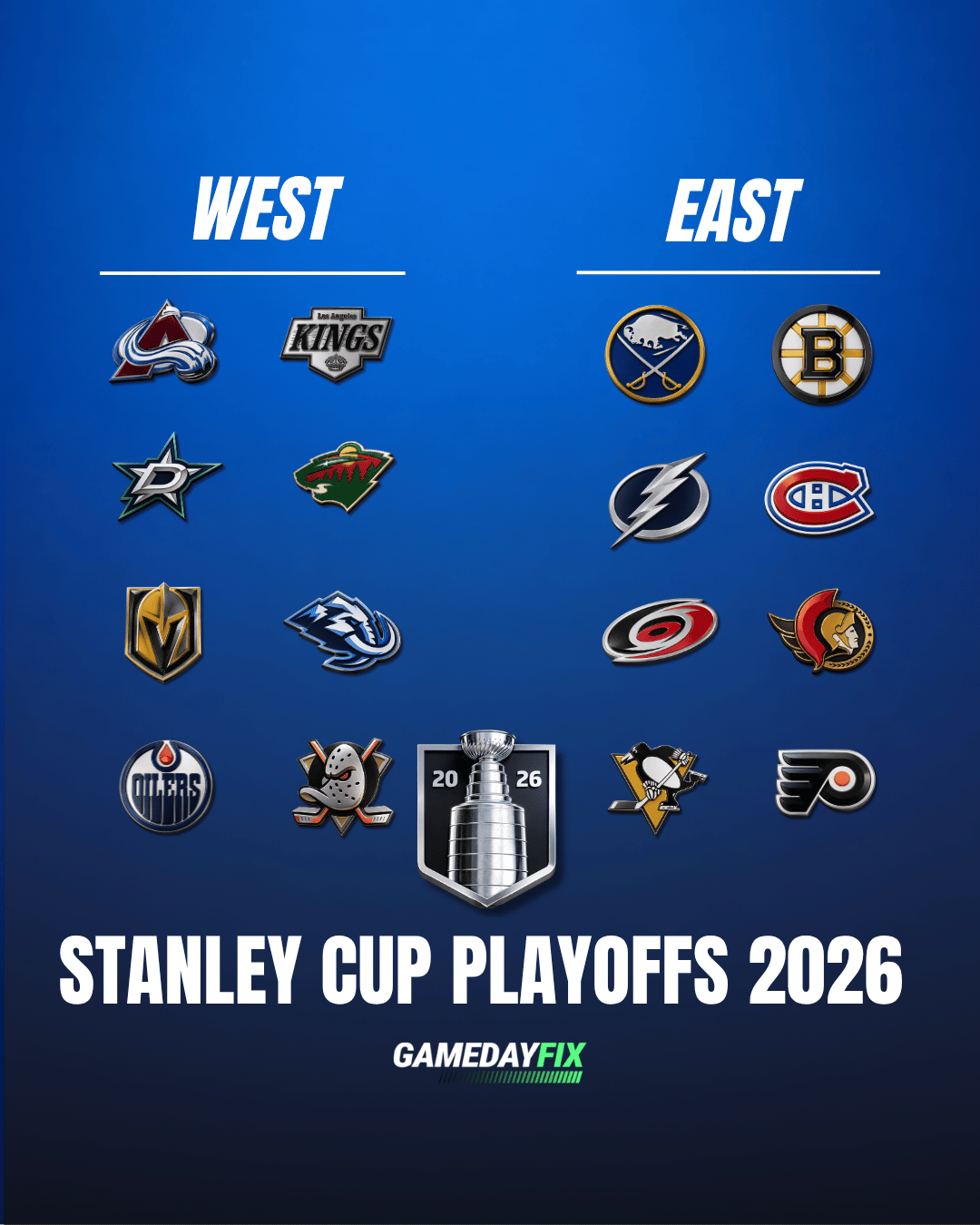
The Stanley Cup Playoffs are set, and this year’s bracket delivers exactly what fans expect this time of year. Contenders built for deep runs, rising teams looking to break through, and matchups that can shift on a single moment. With puck drop approaching, every team believes, but only a few are truly constructed to survive the grind.
Eastern Conference Breakdown
Buffalo vs Boston leans toward the Bruins, but not without questions. Boston brings structure and experience, with David Pastrnak as their offensive driver and Jeremy Swayman anchoring in net. Buffalo’s path depends on Tage Thompson. If he finds his scoring rhythm early, this series becomes far more competitive than expected.
Tampa Bay vs Montreal is where experience meets hunger. Tampa remains one of the most playoff-ready teams in the league. Nikita Kucherov controls the pace offensively, and Andrei Vasilevskiy still gives them an edge every night. Montreal continues to rise behind Nick Suzuki and Cole Caufield, but Juraj Slafkovsky could be the difference maker if his physical game translates over a full series.
Carolina vs Ottawa feels like a turning point matchup. Carolina is built for this stage with depth, structure, and consistency, led by Sebastian Aho. Ottawa brings speed, skill, and edge with Tim Stutzle and Brady Tkachuk. If Ottawa’s young core handles the moment, this has upset potential written all over it.
Pittsburgh vs Philadelphia delivers a classic rivalry with playoff weight. Sidney Crosby remains the focal point and still elevates when it matters most. Philadelphia’s identity revolves around structure and pressure, with Travis Konecny leading offensively. This series comes down to execution in tight games, and it could swing either way.
Western Conference Breakdown
Colorado vs Los Angeles positions the Avalanche as one of the most dangerous teams in the playoffs. Nathan MacKinnon continues to dominate at an elite level, while Cale Makar controls the game from the back end. The Kings will lean on Anze Kopitar and Kevin Fiala, but they will need discipline and near-perfect structure to contain Colorado’s speed.
Dallas vs Minnesota is one of the most balanced matchups in the bracket. Dallas brings depth and consistency with Jason Robertson and Roope Hintz driving their offense. Minnesota has a different look, built around Kirill Kaprizov’s ability to take over games. If Kaprizov finds another level, this series can shift quickly.
Vegas vs Utah introduces unpredictability. Vegas enters with playoff experience and structure, led by Jack Eichel. Utah, however, plays with pace and freedom, making them difficult to prepare for. Clayton Keller stands out as the player who can tilt this series if given time and space.
Edmonton vs Anaheim favors the Oilers on paper, but pressure follows expectations. Connor McDavid and Leon Draisaitl remain the most dangerous offensive duo in the league. Anaheim’s young core, including Trevor Zegras and Mason McTavish, will need a breakout performance to challenge a team with this level of firepower.
Odds and Underdogs
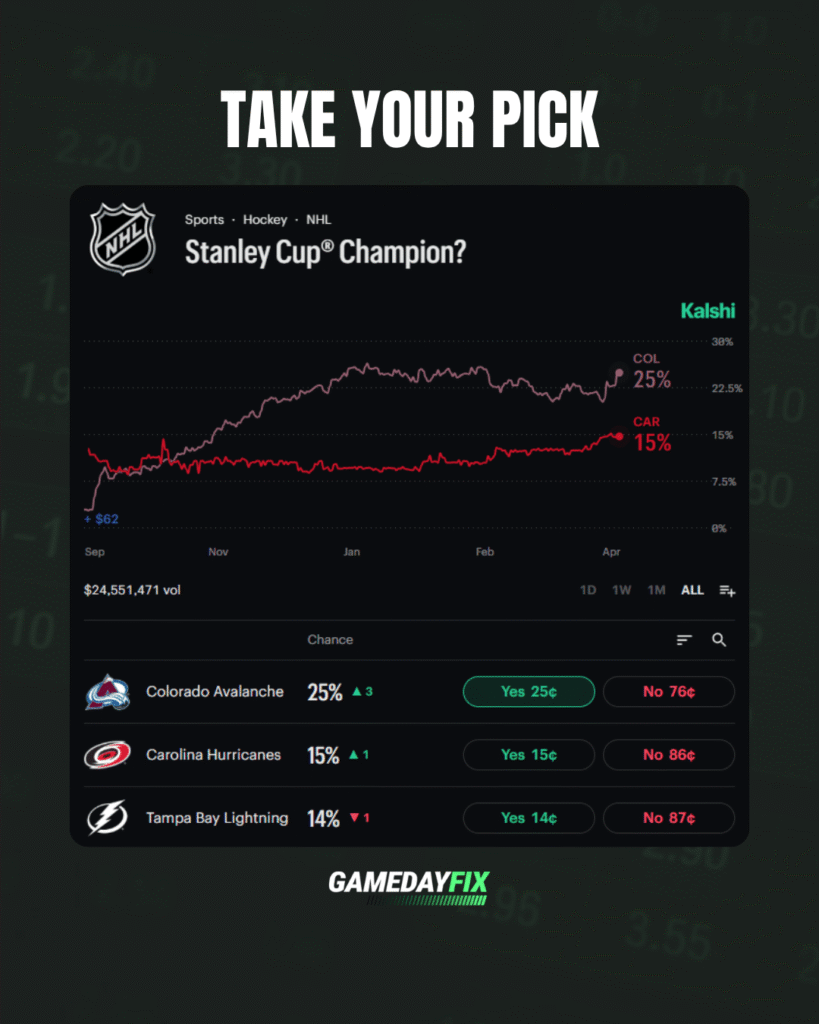
Colorado and Dallas enter as two of the most complete teams in the field, both typically sitting in the +600 to +900 range to win the Cup. Tampa Bay and Carolina are right there as well, built for playoff hockey with proven systems, depth, and elite goaltending. Minnesota sits just behind that tier but has the roster to make a serious run if everything clicks.
These are the teams that feel built for the long stretch. They defend well, roll lines, and have players who can take over moments when games tighten.
The most slept-on team in the East is Ottawa. Their combination of skill, physicality, and confidence gives them the tools to disrupt a structured opponent. In the West, Utah carries that same underdog energy. They are fast, unpredictable, and capable of flipping a series with momentum.
The playoffs always create new stars, but the foundation remains the same. MacKinnon, Kucherov, Aho, Kaprizov, and Robertson will shape the path, but it is often the unexpected player who ultimately defines who lifts the Stanley Cup.
The question surrounding the Calder Trophy race is becoming harder to ignore: has Matthew Schaefer already done enough to win?
As the 2026 NHL season winds down, the rookie conversation remains one of the league’s most compelling storylines. Several first-year players have built strong cases and positioned themselves as legitimate finalists. But while the race appears competitive on the surface, Schaefer’s season continues to separate itself in both context and overall impact.
And that’s where the debate shifts.
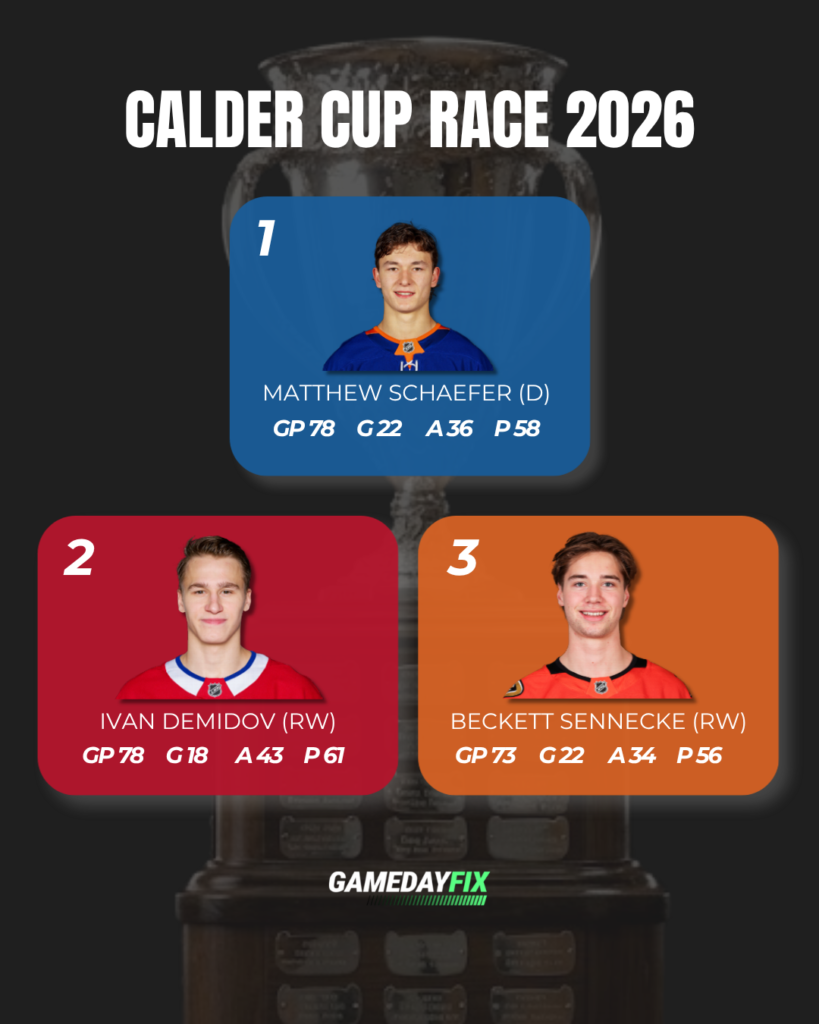
At just 18 years old, Schaefer has recorded 22 goals and 58 points — production that is impressive in any situation, but even more remarkable given his role as a defenseman. Offensive output from the blue line at this level is rare, and historically, players at his position require years to reach this kind of consistency.
Schaefer has done it immediately.
More importantly, his value extends far beyond the scoresheet. He’s logging meaningful minutes, contributing in all situations, and influencing the game at both ends of the ice. The level of responsibility he’s been trusted with — especially at his age — adds significant weight to his Calder Trophy case.
This isn’t just about production. It’s about impact.
Still, the race isn’t without serious challengers.
Ivan Demidov has led all rookies in total points, consistently driving offense and showcasing elite playmaking ability throughout the season. Beckett Sennecke, meanwhile, has emerged as one of the top goal scorers in this rookie class, matching the lead in goals and proving to be a reliable finisher night after night.
Both players have built strong statistical résumés — and under traditional voting patterns, that kind of offensive production often carries significant influence.
But context matters.
High-end scoring from forwards is expected. A defenseman producing at this level — while also handling top-pair responsibilities — is not. When factoring in positional difficulty, usage, and two-way impact, Schaefer’s season begins to stand apart in a much more meaningful way.
It becomes less about who leads the stat sheet — and more about who has delivered the most complete season.
From a voter’s perspective, that distinction is critical.
There is still time left in the season, and late surges can always influence perception. A strong push from Demidov or Sennecke could tighten the race heading into the final stretch. But as it stands, Schaefer has already built a body of work that is difficult to overlook — one that combines production, responsibility, and historical significance.
And that combination is often what defines a Calder Trophy winner.
Because in the end, this award has never been just about numbers.
And if that holds true again this year, the Calder Trophy race may not be as open as it seems.